Friday, December 3, 2010

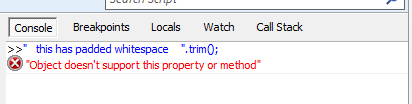
IE Doesn't Support the trim() Method(!)

Here's yet another shocker from the half-baked world of Internet Explorer. Start up IE 8. Press F12 or start the Developer Tools. Then, click the Script tab and then the Console tab on the right pane. At the command line at the bottom, type
[sourcecode language="javascript"]
" this has padded whitespace ".trim();
[/sourcecode]
press Enter, and behold:


Insane! Thankfully, the folks at jQuery have taken care of this.

Thursday, December 2, 2010

Tuesday, November 30, 2010

Java as DSL

I love it:

http://twitter.com/#!/avalanche123/status/7062890318143488

Monday, November 22, 2010

Generate a Version 4 UUID With Javascript

[sourcecode language="javascript"]
function uuid4() {
return "xxxxxxxx-xxxx-4xxx-yxxx-xxxxxxxxxxxx"
.replace(/[xy]/g, function (c) {
var r = Math.random() * 16 | 0, v = c == "x" ? r : r & 0x3 | 0x8;
return v.toString(16);
});
}
[/sourcecode]

From Mvc2.TaskUI by Jonathan Oliver.

Thursday, November 18, 2010

Roll Your Own Map/Reduce in Javascript

I’ve been working on a very Javascript-heavy UI that allows the user to manipulate collections of objects. To ease the task of manipulation, I created a few methods on Array.prototype, which I rolled into a file I call iterable.js:

[sourcecode language="javascript"]
var Iterable = {
func: {
predicate: {
TRUE: function (x) { return true; }
}
}
};

Array.prototype.forEach = function (fn) {
for (var i = 0; i < this.length; i++)
fn(this[i]);
};

Array.prototype.filter = function (pred) {
var result = [];
this.forEach(function (x) {
if (pred(x))
result.push(x);
});

return result;
};

Array.prototype.distinct = function () {
var result = [];
this.forEach(function (x) {
if (!result.any(function (y) { return y == x; }))
result.push(x);
});

return result;
};

Array.prototype.any = function (pred) {
pred = pred || Iterable.func.predicate.TRUE;

for (var i = 0; i < this.length; i++)
if (pred(this[i]))
return true;

return false;
};

Array.prototype.indexOf = function (expr) {
if (!(expr instanceof Function))
expr = function (x) { return x == expr; };

for (var i = 0; i < this.length; i++)
if (expr(this[i]))
return i;

return -1;
};

Array.prototype.singleOrNull = function (pred) {
var filtered = this.filter(pred);
if (filtered.length == 0)
return null;
if (filtered.length > 1)
throw "More than one element returned.";

return filtered[0];
};

Array.prototype.map = function (fn) {
var mapped = [];
this.forEach(function (x) { mapped.push(fn(x)); });
return mapped;
};

Array.prototype.groupBy = function (sel) {
var groups = [];

this.forEach(function (x) {
var group = groups.singleOrNull(function (y) { return y.key == sel(x); });
if (!group)
groups.push({ key: sel(x), members: [x] });
else
group.members.push(x);
});

return groups;
};
[/sourcecode]

Note that this not particularly complete; for example, you’ll see that there is no implementation of a reduce function. It’s not here because I have not needed it in my project yet, nor am I likely to. But it would be easy to implement:

[sourcecode language="javascript"]
Array.prototype.reduce = function (fn) {
    if (this.length == 1)
        return this[0];
    return fn(this[0], this.slice(1).reduce(fn));
};
[/sourcecode]

Now, I’m aware of Underscore and others, so why did I do this? For two reasons, mainly: I only needed a subset of the functions that those libraries offer, and besides, it was fun.
Tuesday, June 8, 2010

The .Net HashSet

I’m relatively new to .Net, coming from the world of Java. Now, the documentation of the HashSet class says, “The HashSet(Of T) class provides high performance set operations. A set is a collection that contains no duplicate elements, and whose elements are in no particular order.” Fair enough, except that the HashSet class preserves insertion order. Furthermore, set1.Equals(set2) will return false even when the two sets contain the same elements but in a different insertion order.

This doesn’t sound like set semantics to me. Fortunately, you can remedy this with a simple extension method and LINQ:

[sourcecode language="csharp"]
public static bool SetEquals<T>(this HashSet<T> me, HashSet<T> other)
{
return me.All(other.Contains) && other.All(me.Contains);
}
[/sourcecode]

As you can see, the LINQ expression on line 3 is equivalent to the definition of set equality. Of course, the parameters to this method could be of type ICollection<T> or something for more genericity.

Monday, March 8, 2010

Endless Code


Bad Code from unclebob on Vimeo:

[vimeo 9981123]


FYI: The piece heard in this video is Atmosphères by György Sándor Ligeti, who intended the listener “to become lost in the depth of the texture and tone and become completely oblivious to the passage of time,” according to Wikipedia.